Three people interviewed your top candidate last week. One left a quick thought in a Slack DM, another typed out an email that never got forwarded and the third forgot to write anything down at all. By Thursday, when the hiring manager finally asks, “So, are we moving forward?” Nobody has a straight answer. Before you can untangle the mess, the candidate emails to let you know she has accepted an offer somewhere else.
Here is the hard truth about interview feedback: forming an opinion about a candidate is actually the easy part. Getting that opinion in front of the people who make the decision, fast enough to matter, is the part that quietly breaks most hiring processes. When feedback is scattered across different tools and trapped in people’s memories, you lose momentum, clarity and ultimately, great talent. But it does not have to be this way.
In this guide, we will show you exactly how to stop losing vital feedback between the interview and the final decision. Read on for a practical framework, interview feedback examples, form template, 40+ copy-and-paste feedback examples and ready-to-send rejection email templates, everything your hiring team needs to give faster, fairer feedback.
TL;DR
Interview feedback is the internal note your hiring team writes about how a candidate performed, evidence tied to the role’s requirements, ending in a clear recommendation. It is different from a rejection email, which is what the candidate actually reads.
Write it within 24 hours. Lead with your recommendation (strong hire/hire / no hire/hold), then back it with specific evidence, not general impressions. Memory edits itself fast, same-day notes are more reliable than notes written a week later.
This guide gives you 40+ copy-and-paste feedback examples (positive, constructive, negative, technical, and scorecard-ready comments), a free interview evaluation form template, and 4 ready-to-send candidate rejection email templates.
The usual failure point isn’t bad feedback; it is good feedback that dies in a Slack thread, a forwarded email, or a merged spreadsheet cell before the hiring team can act on it.
The fix: keep feedback on the candidate’s profile, not scattered across six tools. That’s what Internal Notes in easy.jobs (further down this guide) is built for.
What Is Interview Feedback?
Interview feedback is a written or verbal assessment of how a candidate performed in an interview. It records what the interviewer observed, ties those observations to the skills the role requires and ends with a clear recommendation to move forward, reject or hold, so the hiring team can decide.
Feedback travels in two directions and most teams only think about one of them.
Inward, to your hiring team: the note that tells your colleagues what you saw, so the group can reach a decision together. Outward, to the candidate: the note that tells someone why they did not get the job or what impressed you.
The outward kind gets all the attention. The inward kind is where hiring actually stalls and it is where most of this guide is aimed, this is a guide to feedback shared between interviewers, recruiters, hiring managers and HR, not feedback sent to candidates. When we do cover the outward kind, the rejection emails and post-interview responses your candidates actually read, we will say so explicitly, in the template section near the end.
Interview Feedback at Every Stage of the Recruitment Process
Most hiring processes run more than one interview and feedback needs to survive every handoff between them, not just the final round.
A screening call needs a different kind of feedback than a technical round and a technical round needs different feedback than a final panel. Write it for the stage it is actually assessing:
Screening call: fit on the basics, availability, salary expectations, the non-negotiables. Short and factual.
Skills or technical round: the specific evidence that maps to the role’s core competencies (see the technical examples below).
Panel or final round: whether the signal from earlier stages holds up once the whole team has weighed in.
The mistake most recruitment processes make is not inside any single interview, it is losing the thread between them. The screener’s note on comp expectations should still be visible to whoever runs the final panel three weeks later. That is the whole argument for keeping feedback on the candidate’s profile instead of whoever happened to write it down. More on that below.
Interview Evaluation Feedback Examples
Every example below follows the same shape: the situation, the feedback you can write and a one-line note on why it works. Copy them, change the specifics, use them.
Positive Interview Feedback Examples
Situation: Strong Technical Answer
“Walked through her approach to the caching problem without prompting, including the tradeoff she’d chosen against and why. Explained it clearly enough that our non-technical panellist followed it. Strongest technical answer we’ve had for this role.”
Why it works: it names the specific moment, not the impression.
Situation: Great Culture Add
“Pushed back on one of our assumptions about the roadmap, politely, with a reason. That is the kind of disagreement this team needs more of. Recommend moving forward.”
Why it works: “culture add” is meaningless without a concrete example. This one has one.
Situation: Excellent Communication
“Structured every answer: context, action, result. Never rambled, never over-explained. In a role that spends half its time writing docs for other teams, this is the single most relevant signal we got today.”
Why it works: it links the observation directly to the job.
Situation: Strong Problem-Solving Under Ambiguity
“I gave her a deliberately underspecified brief. She asked four clarifying questions before touching it. All four were the right ones. Didn’t guess, did not freeze.”
Why it works: it describes behaviour, which is repeatable evidence.
Situation: Asked Genuinely Good Questions
“Asked how we handle disagreement between design and engineering, then followed up on my answer. He’d clearly read the case study on our site. Came prepared, not rehearsed.”
Why it works: it distinguishes preparation from performance.
Situation: Strong Portfolio Walkthrough
“Presented three projects and volunteered what went wrong in each without being asked. The second project failed and he explained exactly why. That level of candour is rare at this stage.”
Why it works: it captures a moment the panel would otherwise forget.
Constructive Interview Feedback Examples
Situation: Right Skills, Wrong Level
“Technically solid, no concerns about the core skills. But every example she gave was execution, not direction. For a senior role that sets the roadmap, I did not see enough evidence of leading a decision. Would be a strong hire one level down.”
Why it works: it separates capability from fit, which prevents a good candidate being written off entirely.
Situation: Good Answers, Poor Structure
“The content was there but it took a long time to arrive. Answers ran three or four minutes before reaching the point. This matters for a client-facing role; it may not matter for this one. Flagging it for the panel to weigh.”
Why it works: it names the concern and its relevance, without overstating it.
Situation: Strong on Paper, Quiet in the Panel
“Noticeably more comfortable in the one-to-one than in the group session. Worth considering whether the panel format worked against him rather than reading it as a lack of confidence. I’d want a second conversation before deciding.”
Why it works: it questions the process, not just the candidate.
Situation: Needs Mentoring
“Instincts are good, foundations are patchy. Solved the problem but could not explain why her solution worked. In a team with the capacity to mentor, this is a strong yes. In a team that needs someone shipping in week two, it is not.”
Why it works: it makes the decision conditional on something the team actually knows.
Situation: Specific Stack Gap
“Everything transfers except the infrastructure side, no hands-on Kubernetes and she was upfront about it. Question for the team: is that a six-week gap or a six-month one?”
Why it works: it converts a vague worry into a question the group can answer.
Situation: Strong Candidate, Weak Preparation
“Clearly capable, but hadn’t looked at the product before the call. Might just be a busy week. I’d give a second chance, with a clear expectation set beforehand.”
Why it works: it distinguishes a one-off from a pattern.
Negative Interview Feedback Examples
Situation: Clear Skills Gap
“Couldn’t complete the core exercise and the gaps were foundational rather than niche. Struggled with the data modelling step, which is the first thing this role does every week. Not a fit for this position.”
Why it works: it points to the requirement, not the person.
Situation: Culture Misalignment
“Asked repeatedly about individual performance metrics and how quickly he could get promoted. Asked nothing about the team or the customer. For a role built on cross-functional work, that is a mismatch. Recommend we pass.”
Why it works: it uses evidence, not vibes. “Not a culture fit” with no example is where bias hides.
Situation: Poor Preparation
“Didn’t know what we were doing. Asked what the product was, ten minutes into a final-round interview. No further questions from me.”
Why it works: it is short, factual and unarguable.
Situation: Could Not Back Up the CV
“The CV claims she led the migration. When I asked what the hardest decision in that migration was, she could not name one and moved to talking about the team. I asked twice. Concerned the ownership on the CV is overstated.”
Why it works: it records the question you asked, which makes the conclusion checkable.
Situation: Unprofessional Conduct
“Spoke dismissively about a former colleague by name, unprompted. Two interviewers noticed independently. That is a red flag regardless of skill level.”
Why it works: it notes corroboration, which makes it defensible.
Situation: Compensation Far Outside Band
“Genuinely one of the stronger candidates. But she is looking for 40% above the top of the band and was clear that she would not move on it. Nothing to fix here, recommend we close it out honestly rather than string it along.”
Why it works: it is a “no” that protects the relationship.
Feedback to Share With Unsuccessful Candidates
This is feedback the candidate actually reads. Be specific enough to be useful, kind enough to be human and careful enough to be legally safe. (Want full, ready-to-send rejection emails built around scenarios like these? See the candidate rejection email templates further down this guide.)
Skills gap
“Thank you for the time you gave us. We have decided to move forward with another candidate whose experience with large-scale data migrations was closer to what this role needs from day one. Your product thinking stood out and I’d genuinely encourage you to apply again as our team grows.”
Strong candidate, stronger competition
“This was a close decision. You interviewed well and the panel was divided. The candidate we chose had run a comparable team through a restructure, which is the specific challenge this role opens with. That is the difference, it is not a judgement on your ability.”
Interview performance
“Your written exercise was among the strongest we received. In the panel session, several of your answers stayed at a high level and the team wanted more concrete detail on your own contribution. If you’d find it useful, I’m happy to talk that through on a call.”
Too junior for the role
“We have decided not to move forward for this position, which needs someone who’s already owned a roadmap. That said, we were impressed enough that I’ve passed your details to the team hiring at the mid level, if you’d be open to that conversation.”
Culture mismatch, handled honestly
“After the panel, we felt the way this team works, a lot of autonomy, very little process, may not be the environment where you’d do your best work, based on what you told us you are looking for. We’d rather be straight with you now than six months in.”
What not to write: anything about age, health, family, accent, appearance or “energy.” Anything you could not evidence. Anything you would not want read aloud in a tribunal. If you can not say it specifically, do not say it.
Technical Interview Feedback Examples
Code quality
“Working solution in 25 minutes. Named things well, handled the empty-input case without being asked and wrote one test unprompted. Didn’t over-optimise prematurely. This is what I want to see.”
System design
“Started with the constraints instead of the diagram, which is the right instinct. Under-specified the failure modes, when I pushed on what happens if the queue backs up, the answer was thin. Solid mid-level design; not yet senior.”
Debugging approach
“Given a broken function, he read it before running it. Formed a hypothesis, tested that hypothesis and was done in six minutes. Method over guesswork.”
Depth vs. breadth
“Knows a little about a lot. When I went deep on the one area she claims as a specialism, it held up for two questions and then did not. For a generalist role, fine. For this one, a concern.”
Explaining technical work to non-technical people
“Our ops lead sat in and understood the whole answer. The candidate checked in twice to make sure she was pitching it right. That skill is half of this job.”
Quick Interview Feedback Comments & Remarks for Scorecards
Short lines for scorecards, when you do not need a paragraph.
SignalCommentStrong hireClearest thinker we’ve seen for this role. Move to final.Strong hireEvery claim on the CV held up under questioning.HireSolid across the board, no standout weakness. Yes from me.HireWould ramp slower than ideal, but the ceiling is high.Leaning yesStrong skills, unclear motivation. Worth one more conversation.Leaning yesGood candidate, wrong first impression. Recommend a second panel.Leaning noCapable, but not for this role at this level.Leaning noAnswers stayed general. Asked twice for specifics, did not get them.No hireCore skills gap on the primary requirement.No hirePrepared for a different job than the one we’re hiring for.No hireCorroborated concern about conduct. Two interviewers, independently.HoldStrong, but I want the hiring manager’s reading before we commit.
Interview Evaluation Form & Free Feedback Template
An interview evaluation form is not bureaucracy, it is the thing that stops three interviewers from evaluating three different jobs. Include these fields and nothing you can not act on:
Role and interview stage: feedback for a screen and a final round are not the same document.
Interviewer name and date: you will need to know who saw what and when memory was still fresh.
Competencies, rated: the 4–6 things this role actually requires. Same list for every interviewer, every candidate. This is the field that does the most work against bias.
Evidence for each rating: one line per competency, describing what the candidate actually did or said. A rating without evidence is a feeling with a number attached.
Strengths: two or three, specific.
Concerns or gaps: with a note on whether they are fixable.
Recommendation: strong hire / hire / no hire / hold. Forcing a choice, “maybe” helps nobody.
Suggested next step: who does what, by when.
The point of the form is not the form. It is that everyone answers the same questions, so the panel is comparing like with like.
Free Interview Feedback Template
We have put the above into a template you can copy, available as a PDF, no email required.
Download it, copy it, cut what does not apply and make it yours. It is a starting point, not a standard.
How to Write & Share Interview Feedback with Your Hiring Team
How to Give Interview Feedback to a Hiring Manager
The hiring manager does not need your narrative. They need to make a decision. Give them the decision first.
Lead with the recommendation. Strong hire, hire, no hire, hold. Put it in the first line. Everything after that is your reasoning and they’ll read it if they need to.
Give evidence, not impressions. “Didn’t explain his caching choice when asked twice” is evidence. “Seemed weak technically” is a feeling. One of these can be argued with; the other just lands and stays.
Separate what you saw from what you concluded. “She gave three examples, all from the same project” is what you saw. “I think her experience is narrower than the CV suggests” is what you concluded. Label them differently.
Name the one thing that would change your mind. This is the most useful sentence you can write. “I’d flip to a yes if she can show she is led a team through a migration.”
Send it within 24 hours. After a day, memory starts editing itself to match the impression you formed in the first five minutes. Write it while the detail is still there.
How to Write Interview Feedback to HR
HR needs something different from what the hiring manager needs and sending the same note to both is why so much feedback gets ignored.
The hiring manager wants your judgement. HR wants the record: what was assessed, against what criteria, with what evidence, leading to what outcome. That record is what protects the company if a rejected candidate ever challenges the decision, and it is what makes your process auditable rather than anecdotal.
Worked example:
Candidate: A. Ronald, Senior Support Engineer, final round, 12 June Assessed against: troubleshooting, customer communication, escalation judgement, systems knowledge Evidence: Completed the diagnostic exercise correctly (troubleshooting: strong). Explained the fix to a non-technical panellist clearly (communication: strong). When asked when he’d escalate, described a threshold well above our policy and did not revise it when prompted (escalation judgement: below requirement). Recommendation: No hire for this role. The escalation gap is central to the position and not a quick fix. Next step: Close out with feedback offered. Suggest reconsidering for the mid-level opening in Q4.
Notice what is not in there: adjectives, personality, guesses. Just criteria, evidence and an outcome.
How Soon After the Interview Should You Give Feedback?
Within 24 hours, ideally before you leave the building or close the laptop.
Memory does not hold steady; it edits itself to match the first impression you formed in the opening five minutes. Every day you wait, the specific detail (the exact question, the exact pause, the exact answer) fades and what is left is a vague, more bias-prone summary. Post-interview feedback written the same day is measurably more useful to the panel than feedback written a week later, even when the writer is confident their memory has not changed.
If a debrief is scheduled, submit written feedback before it starts. Feedback submitted after everyone has already spoken tends to just agree with whoever spoke first.
The Problem: Your Feedback Is Scattered Across Slack, Email and Spreadsheets
Here is where all of the above quietly falls apart.
You write good feedback. It goes into a Slack thread. Two hours later the thread has scrolled past and the hiring manager, who wasn’t in that channel, never sees it. Someone else emails theirs to HR, who forwards it to the recruiter, who’s on leave. A third person puts it in the spreadsheet, in a merged cell, which nobody opens because the spreadsheet is where feedback goes to die.
Then, two weeks later, four people sit down to make a decision and what they are actually working from is not the feedback at all. It is what they remember. And what they remember is the first impression, sanded smooth by a fortnight of forgetting.
The candidate you lose is not lost because you judged her badly. She’s lost because the judgement never arrived anywhere in time.
So the real question is not how do I write good interview feedback, you can already do that; the examples above are proof. The question is: where should it live?
Where Interview Feedback Should Live: Your ATS, Not Your Inbox
For a small team, the honest answer is that feedback should live in the same place as the candidate.
Most WordPress site owners, agencies and small businesses hire without an applicant tracking system. There is a careers page, an email inbox and everything after that is improvisation. That works at two hires a year. It falls apart at ten and it falls apart badly at the exact moment you are hiring fast and can least afford to lose people.
What a small team actually needs is unglamorous:
One candidate profile, everything about that person in one place, not four
One conversation, attached to the profile, not scattered across tools that were never built for hiring
One record, so that in six months you can see why you said no and so a colleague joining the panel late can catch up in two minutes instead of asking everyone to explain again
If you are hiring from a WordPress site, it is worth reading our comparison of the best WordPress job board plugins, because the tool that publishes your job and the tool that holds the hiring conversation really should be the same one. Otherwise you are back to copy-pasting between systems, which is where feedback goes missing in the first place.
Which brings us to the feature we built for exactly this problem.
Introducing Internal Notes in easy.jobs: Keep Hiring Feedback Where the Decision Happens
Everything above gets easier when the feedback lives on the candidate’s profile instead of across six tools.
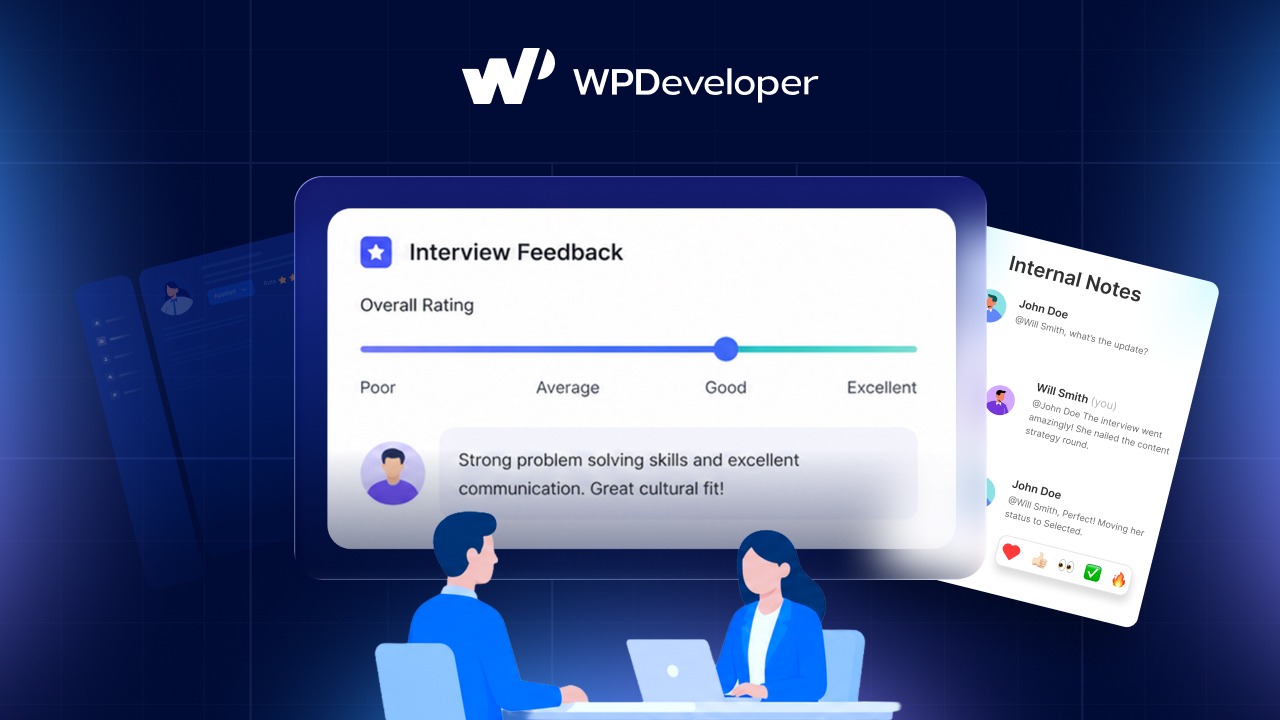
That is what Internal Notes does. It is a private conversation for your hiring team, attached to the candidate you are discussing, visible to your team, never to the candidate.
Threaded replies: one conversation per candidate, not per Slack channel
Feedback goes on the profile and replies thread underneath it. The disagreement about whether the caching answer was good enough stays attached to the caching answer. Six weeks later, when someone asks why you passed on her, the whole reasoning is still there, in order.
@mention a teammate to pull them into the decision
The hiring manager is not in your Slack channel and shouldn’t have to be. @mention them on the note and they are notified, they arrive with the context already loaded, instead of asking someone to explain it again.
Reactions and emoji for fast async sign-off
Not every response needs a paragraph. Sometimes the panel just needs to know that everyone agrees. A on the note does what a nine-message “+1” email chain does, in a second, without four notifications.
Who can see internal notes?
Your team and only your team. Internal Notes are never visible to candidates, not in the application portal, not in any email, not anywhere. Access follows the team permissions you have already set in easy.jobs, so a hiring manager on one role does not see notes on another.
How to add your first internal note
Open the candidate’s profile in your easy.jobs pipeline.
Go to the Internal Notes tab.
Write your feedback, @mention anyone whose input you need.
Post it. Your team is notified; the candidate is not.
For a closer look at what this does to your hiring speed, read how internal notes speed up hiring decisions.
Using easy.jobs from your WordPress dashboard
If your careers page lives on WordPress, easy.jobs runs from the WordPress dashboard, job posts, pipeline and now the hiring conversation, without leaving the site you already manage.
Interview Feedback Best Practices
Write it within 24 hours. After that, you are not recording an interview, you are recording a memory of one.
Specific beats vague. “Didn’t explain his caching choice when asked twice” is useful. “Seemed weak technically” is not.
Separate fact from impression, and label which is which. Both belong in the note. Confusing them is how bias gets laundered into evidence.
Tie every point to a competency on the scorecard. If a comment does not map to something the role requires, ask yourself why you are making it.
Tag the next action, not just the verdict. “No” ends a note. “No, closing out today, suggest we revisit for the Q4 role” ends a decision.
Write nothing you would not want read aloud in a tribunal. Not as a scare tactic, as a filter. It is a fast way to catch the comments that were never really about the job.
Give the quiet interviewer a way to disagree. The most senior voice speaks first in the room and the panel converges on it. Written, threaded feedback, submitted before the debrief, is the cheapest fix for that there is.
Candidate Rejection Email & Post-Interview Response Templates
Everything above is written for your hiring team. This section is different on purpose: it is the feedback your candidate actually reads, formatted as a full email you can send.
The reasoning behind each of these should already be sitting in your Internal Notes thread. That is what makes writing the email fast, you are translating a decision you have already recorded, not reconstructing it from memory two weeks later.
A few ground rules before the templates: reply within a few business days of the final decision, double-check the name and role in every field before sending (a mail-merge mistake is a fast way to lose someone’s trust) and hold to the same standard from the “what not to write” note above, specific, evidenced and nothing you would not want read back to you.
Template 1: Post-Interview Holding Response (Decision Still Pending)
Use this when you have interviewed a candidate but the process, other interviews, internal sign-off, is not finished yet. It is not a rejection; it is a status update.
Subject: Thanks for interviewing for [Job Title], here is what is next
Hi [Candidate Name],
Thank you for taking the time to meet with us for the [Job Title] role. We enjoyed the conversation and wanted to give you a clear update rather than leave you waiting.
We are still completing interviews with a small number of other candidates. We expect to make a decision by [date] and I’ll follow up with you either way, you won’t need to chase us for an answer.
In the meantime, feel free to reach out if anything comes up.
Best, [Your Name]
Template 2: Rejection After an Early-Stage Screen
Use this for candidates who did not make it past a first call or application review. Keep it brief, this stage does not call for extensive personalisation.
Subject: Update on your application for [Job Title] at [Company]
Hi [Candidate Name],
Thank you for taking the time to speak with us about the [Job Title] role. After reviewing candidates from this stage, we’ve decided to move forward with applicants whose experience more closely matches what we need right now.
We appreciate the time you invested and we will keep your details on file for roles that fit your background in future.
Wishing you the best with your search.
Best, [Your Name]
Template 3: Rejection After a Final-Round Interview
Use this when a candidate has invested real time, a panel, a technical exercise, multiple rounds. It earns a specific, named reason.
Subject: Your interview for [Job Title], an update from [Company]
Hi [Candidate Name],
Thank you for the time and thought you put into the final round for [Job Title]. This was a genuinely close decision and the panel enjoyed speaking with you.
We have decided to move forward with a candidate whose [specific relevant experience, e.g. “experience leading a team through a similar restructure”] was a closer match for what this role needs right now. That is the difference, it is not a judgement on your ability and [specific positive, e.g. “your technical answers were some of the strongest we saw this round”].
We’d welcome the chance to speak again if a role at this level opens up.
Best, [Your Name]
Template 4: Rejection With a Redirect (Different Role or Talent Pool)
Use this when a candidate is strong but not right for this role, wrong level, wrong specialism or simply no current opening.
Subject: Following up on your [Job Title] interview
Hi [Candidate Name],
We have decided not to move forward with your application for [Job Title], the role needs someone who’s already [specific requirement, e.g. “owned a roadmap end to end”]. That is a fairly narrow bar and it is not a reflection of the strengths you showed us.
We were impressed enough that I’d like to keep your details for [Team/Function, e.g. “our mid-level openings” or “future roles on this team”] and I’ll reach out directly if something matching comes up. You’re also welcome to apply again in the meantime.
Best, [Your Name]
Frequently Asked Questions on Interview Evaluation
How Do You Write Interview Feedback?
Start with your recommendation, then support it with specific evidence tied to the skills the role requires. Describe what the candidate actually said or did, not the impression it left. Keep facts and conclusions separate and finish with a clear next step.
What Are Good Examples of Positive Interview Feedback?
The best positive feedback names a specific moment: “Walked through her caching tradeoff without prompting and explained it clearly enough for our non-technical panellist to follow.” Praise without an example, “great candidate,” “good energy”, gives the hiring team nothing to act on.
How Do You Give Negative Interview Feedback without Being Harsh?
Point at the requirement, not the person. “The role does data modelling weekly and that was the step that did not come together” is a fact about the job. “He wasn’t very sharp” is a verdict on a human being. The first is fair, useful and defensible.
How Do You Share Interview Feedback with A Hiring Manager?
Lead with the recommendation so they can act immediately, then give the evidence beneath it. User easy.jobs internal notes if you are using this ATS and send it within 24 hours and name the one thing that would change your mind, that single line saves more hiring debates than anything else you can write.
What Should an Interview Evaluation Form Include?
Role and stage, interviewer and date, the 4–6 competencies the role requires with a rating and evidence for each, strengths, concerns, a forced recommendation and a suggested next step. The same fields for every interviewer, that is what makes candidates comparable.
How Soon After an Interview Should You Give Feedback?
Within 24 hours. Memory edits itself to match the first impression within a day or two, so feedback written same-day is measurably more reliable than feedback written a week later, even when the interviewer feels confident their memory has not changed.
What is The Difference Between Interview Feedback And Candidate Feedback on The Recruitment Process?
They are opposites and it is easy to mix them up because the phrasing is so close. Interview feedback (what this guide covers) is written by your hiring team about how the candidate performed. Candidate feedback on the recruitment process is the reverse, feedback the candidate gives you about their experience applying and interviewing, usually collected through a short post-process survey. Both are useful; they just answer different questions.
Can I Turn Interview Feedback into A Candidate Rejection Email?
Not directly. Internal feedback is written for your hiring team and can include comparative or blunt language, scoring, “leaning no,” direct comparisons to other candidates that should never reach a candidate.
Use the internal note as your source of truth, then rewrite it for the candidate: keep the specific, evidenced part and drop anything comparative, numerical or internal-only. The rejection email templates earlier in this guide are built for exactly this handoff.
Are Internal Notes in easy.jobs Visible to Candidates?
No. In easy.jobs, Internal Notes are visible only to your hiring team and never to the candidate, not in the portal, not in any email.
Bring Your Hiring Team’s Feedback Into One Place
Good interview feedback is specific, fast and tied to the job. But the best-written feedback in the world is worthless if it is sitting in a Slack thread nobody scrolled back to.
Put the conversation where the decision gets made: on the candidate’s profile, in front of the people who need it.
If you have found this blog insightful, subscribe to our blog. Join our Facebook Community to connect with fellow hiring managers, share recruitment best practices and learn how to build a better, faster hiring process.
The post Interview Feedback Examples, Templates & Best Practices appeared first on WPDeveloper.
Leave a Reply