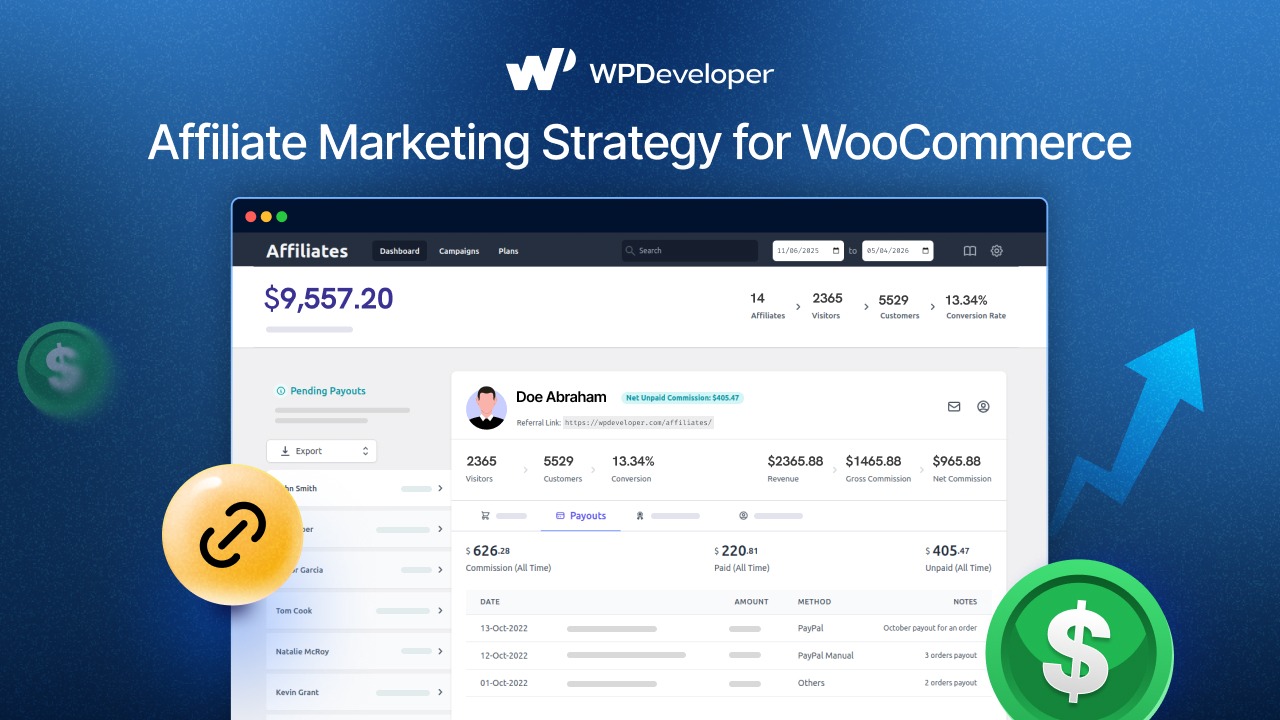
You have built your WooCommerce store. Your products are live, your checkout works and you have invested in SEO and paid ads. But there is a problem you cannot ignore! Customer acquisition costs keep climbing and your marketing budget feels like it is running on a treadmill (spending more just to stay in the same place).
But there is a way to grow. Imagine a system where creators, bloggers and influencers actively promote your WooCommerce store products and you only pay when a sale actually happens and your reach expands without a single extra ad. That affiliate marketing strategy with WooCommerce is one of the most capital-efficient growth strategies available to any eCommerce store.
But here is what most guides do not tell you: from setting up a plugin to providing commissions. Well, setting up an affiliate plugin is the easy part. But you need to build an affiliate marketing strategy that consistently attracts quality affiliates, keeps them motivated and delivers measurable ROI.
This guide gives you exactly that. From defining your affiliate commission structure and learning how to recruit affiliates to choosing the right WooCommerce affiliate plugin and preventing fraud, this is the complete playbook for WooCommerce store owners who want affiliate marketing to actually work.
TL;DR: Channel Strategy At a Glance
Building a successful online store channel strategy comes down to one core idea: be present in the right places, with a brand reputation strong enough to convert customers wherever they find you. Here is everything covered in this guide, condensed into one quick-reference table:
What to DoWhy It MattersQuick WinAudit your current channelsYou cannot build a smarter channel strategy without knowing where your customers are already coming fromOpen Shopify Analytics and identify your top 3 traffic sources by conversion rate, not just volumeStrengthen your Shopify store firstEvery other channel sends traffic here — if it leaks conversions, multichannel expansion just amplifies the problemAdd visible reviews, tighten your mobile experience, and add trust signals at checkoutExpand channels strategicallyAdding channels without a plan spreads effort thin and produces poor results across the boardStart with email, then add one social or marketplace channel at a time based on where your buyers actually areKeep branding consistent everywhereCustomers move fluidly between platforms — a disjointed experience erodes trust faster than any negative reviewAlign your logo, tone, photography, and pricing across every channel before expandingTreat review platforms as a channel95% of consumers read reviews before buying — reviews are the reputation layer that sits beneath every channel you operateSet up automated review collection so every order generates a review request without manual effortFilter negative reviews privatelyOne visible cluster of unresolved negative reviews suppresses conversion rates across every other channel simultaneouslyUse TrustSync to route poor ratings to a private dashboard before they go publicTrack revenue, not just trafficHigh traffic from a non-converting channel is wasted budgetMeasure CAC and LTV by channel, not just clicks and impressionsMeasure your reputation monthlyReview freshness decays fast — 73% of consumers only trust reviews from the last monthMonitor star rating, review volume, and response rate across all active review platforms
The bottom line: A channel strategy without a reputation strategy is a plan with a leak in it. TrustSync automates review collection across up to 10 platforms simultaneously, filters negative feedback privately, and builds the social proof layer that makes every channel work harder.
What Is WooCommerce Affiliate Marketing And Why Does It Work?
WooCommerce affiliate marketing is a performance based marketing model where you partner with publishers, bloggers, influencers and content creators (your affiliates) who promote your products in exchange for a commission on every sale they generate.
Here is how the mechanics work: each affiliate gets a unique tracking link or coupon code. When a customer clicks that link and completes a purchase on your WooCommerce store, the sale is attributed to that affiliate and they earn their agreed commission. You pay only for results, not clicks, not impressions, not traffic that does not convert.
WooCommerce powers over 6 million active stores in 2025 with a 39% eCommerce market share. As competition intensifies, affiliate marketing has become one of the most effective ways to grow without dramatically increasing ad spend.
Why It Works Better Than Traditional Advertising
Zero upfront risk: Unlike Google Ads or Meta campaigns, where you pay before knowing the outcome, affiliate marketing ROI is guaranteed (commissions only flow when sales happen).
Reach through trust: Affiliates promote to audiences who already follow and trust them, resulting in higher conversion rates than cold traffic from ads
SEO compounding: Affiliate reviews, tutorials and comparison posts generate natural backlinks to your product pages, strengthening your organic rankings over time
Scalability: Adding 10 more affiliates does not require 10 more marketing hires as the system scales through your network, not your headcount
24/7 marketing: Affiliate content (blog posts, YouTube reviews, email sequences) works around the clock without ongoing effort from your team
Who Should Run a WooCommerce Affiliate Program?
Affiliate marketing for eCommerce works across virtually every store type:
Physical product retailers — fashion, beauty, home goods, fitness equipment
Digital product sellers — plugins, courses, eBooks, templates, photography
SaaS and subscription products — recurring commissions make these especially attractive for affiliates
Membership sites — online communities, masterminds, and course platforms
Dropshipping stores — affiliates add reach without adding inventory risk
Things You Need To Take Into Consideration While Setting Your Goals
Before you install a single plugin or recruit your first affiliate, be clear on what you want to achieve for your specific store. Vague goals produce vague results. Use SMART principles:
Specific: ‘Increase WooCommerce revenue by 20% through affiliate sales within 6 months’ is a goal. ‘Get more sales’ is not.
Measurable: Define the key affiliate marketing metrics you will track: number of active affiliates, conversion rate, revenue per affiliate, and commission-to-revenue ratio
Achievable: Calibrate based on your current traffic, product margins, and competitive landscape
Relevant: Make sure affiliate marketing aligns with your broader growth strategy, not just a tactic you’re bolting on
Time-bound: Set milestones at 30, 60, and 90 days to track early momentum
Key Metrics to Define Before You Launch
Affiliate marketing metrics to establish upfront where you target the number of active affiliates at 30/60/90 days
Desired affiliate conversion rate (industry average: 1–5% of referred traffic)
Maximum commission-to-revenue ratio (most sustainable programs keep commissions under 30% of margin)
Minimum monthly revenue target from the affiliate channel
Customer acquisition cost (CAC) through affiliates vs. your current paid channels
Designing Your Affiliate Commission Structure
Your affiliate commission structure is the engine of your program. Set it too low and you will struggle to attract quality affiliates. Set it too high and your margins collapse. The right structure balances genuine incentive with business sustainability and it evolves as your program matures.
Commission Rate Benchmarks by Product Type
Product TypeRecommended CommissionNotesPhysical products5% – 15%Keep margins healthy; test lower rates first and increase for top performersDigital products/downloads20% – 40%Higher margins support aggressive commissions, great for recruiting quality affiliatesSaaS/subscriptions10% – 30% recurringRecurring commissions are powerful motivators for long-term affiliate loyaltyPremium/high-ticket items10% – 20%Lower percentage is fine (absolute dollar value is high enough to incentivize)New/slow-moving productsUp to 40%Use higher rates strategically to accelerate traction on products that need a push
Source: Yuko
Commission Models to Choose From
Percentage-based commissions: The most common model. A fixed percentage of each order value. Easy for affiliates to understand and scales naturally with your average order value
Fixed amount per sale: Works well for uniform-price products. Predictable for both you and the affiliate
Tiered commission structure: Reward top performers with escalating rates. For example: 10% base rate, 15% after 50 sales/month, 20% after 100 sales/month. This is one of the most effective retention strategies for high-value affiliates
Recurring commissions: For subscription products, pay affiliates a percentage of every renewal, not just the first payment. This creates long-term incentive alignment and dramatically increases affiliate loyalty
Lifetime commissions: Affiliates earn on all future purchases made by customers they referred, which is powerful for building a highly motivated affiliate base
The Tiered Commission Model in Practice
A tiered commission structure is particularly effective for WooCommerce stores looking to reward their best performers without overpaying across the board. Here’s a practical example:
Tier 1 (0–25 sales/month): 8% commission
Tier 2 (26–75 sales/month): 12% commission
Tier 3 (76+ sales/month): 18% commission
This structure motivates mid-tier affiliates to push harder (they can see the next level clearly) while rewarding your top performers in proportion to the value they deliver.
Cookie Duration: The Overlooked Setting
Cookie duration determines how long after clicking an affiliate link a customer can complete a purchase and still trigger a commission. The standard is 30 days, but consider:
Short-consideration products (under $50): 7–14 days is sufficient
Mid-consideration products ($50–$300): 30 days is standard
High-consideration products ($300+): 60–90 days is appropriate — longer purchase cycles require longer cookie windows to fairly attribute affiliate referrals
Choosing the Right WooCommerce Affiliate Plugin
WooCommerce does not include affiliate tracking functionality by default. You will need a dedicated WooCommerce affiliate plugin to manage your program. Here is what to look for and the leading options available in 2026.
What to Look for in a WooCommerce Affiliate Plugin
Affiliate tracking WooCommerce: Accurate, real-time tracking of clicks, referrals, and conversions — the foundation of any reliable program
Affiliate coupon codes WooCommerce: The ability to track sales via unique coupon codes (not just links) — essential for influencer and social media affiliates who can’t embed clickable links
Flexible commission rules: Per-product, per-category, per-affiliate, and tiered commission structure support
Affiliate dashboard: A clean, self-serve portal where affiliates can access their links, track earnings, and download creatives without emailing you
Affiliate payout automation: Automated or one-click payouts via PayPal or Stripe to eliminate manual commission processing
Affiliate fraud prevention: Detection of duplicate referrals, self-referrals, and suspicious activity that could drain your commission budget
Marketing asset management: The ability to provide affiliates with banners, copy, and creatives directly through the plugin
Top 5 WooCommerce Affiliate Plugins in 2026
Here is an overview of the leading WooCommerce affiliate plugin options, each suited to different store sizes and needs:
1. FluentAffiliate (by WPManageNinja)
A modern, WooCommerce-focused affiliate management plugin built natively for WordPress. FluentAffiliate offers real-time tracking, flexible commission structures, and a clean, user-friendly dashboard for both admins and affiliates. It includes automated payouts, customizable affiliate portals, and deep WooCommerce integration without relying on third-party platforms. Ideal for stores that want a scalable, all-in-one affiliate system with full data ownership and seamless performance.
2. Affiliate for WooCommerce (by StoreApps/WooCommerce)
The official WooCommerce-endorsed plugin. Includes unlimited affiliates, multi-tier affiliate program support, real-time analytics, affiliate coupon codes for WooCommerce, marketing asset management, and automated payouts. A strong choice for stores that want deep WooCommerce integration and no per-transaction fees.
3. Solid Affiliate
Solid Affiliate is built from the ground up specifically for WooCommerce, not a general WordPress affiliate plugin adapted for WooCommerce. The setup wizard, one-click affiliate portal, and includes all features in a single plugin with no add-ons needed. Ideal for stores that want a clean, purpose-built solution.
4. Coupon Affiliates
Specializes in coupon-based affiliate tracking WooCommerce. Excellent for influencer programs and social media affiliates where coupon codes are the primary tracking mechanism. 4.9/5 stars from 5,000+ stores. Includes detailed analytics, affiliate payout automation, and custom registration forms.
5. Easy Affiliate
Easy Affiliate focused on simplicity and control. Includes real-time tracking, fraud protection, customizable commission structures, and integration with popular email marketing tools. Good for store owners who want a clean setup without a steep learning curve. Starts at $99.60/year.
How to Recruit Affiliates: Building Your Partner Network
Your affiliate program is only as strong as the affiliates in it. Knowing how to recruit affiliates who are genuinely aligned with your niche and audience is the difference between a program that trickles in occasional sales and one that becomes a significant revenue channel.
Start with Your Existing Community
Your warmest and most motivated potential affiliates are already in your orbit:
Happy customers: they have bought from you, they trust your products, and their recommendations carry genuine social proof. Many affiliate plugins let you automatically invite customers after purchase
Email subscribers: people who follow your brand are pre-qualified — they already find your content valuable
Social media followers: particularly those who tag you, leave comments, or already mention your products organically
Set up an automated post-purchase email sequence that invites recent customers to join your affiliate program. A customer who just had a great experience is at their highest point of advocacy — that’s the perfect moment to ask.
Outreach to Relevant Content Creators
Beyond your existing community, targeted outreach to relevant content creators is the most scalable way to recruit affiliates:
Niche bloggers who publish reviews, tutorials, or comparison content in your product category
YouTube creators who produce product reviews, hauls, or tutorial content relevant to your niche
Newsletter writers with engaged subscriber lists in your target market
Podcast hosts in your industry — affiliate links in show notes convert reliably
Instagram, TikTok, and Pinterest creators who already influence purchasing decisions in your category
When reaching out, lead with value. Explain specifically why your products would resonate with their audience and what your affiliate commission structure offers them. Generic outreach gets ignored; personalized outreach gets responses.
List Your Program on Affiliate Networks
Affiliate networks provide access to a marketplace of active affiliates already looking for programs to join. Options that work alongside WooCommerce:
ShareASale (AWIN) — One of the largest affiliate networks with thousands of active publishers
CJ Affiliate — Strong for retail and physical product categories
PartnerStack — Particularly effective for tech and software products
Networks accelerate discovery, but they come with platform fees (usually 20–30% of commissions paid). Use them as a complementary channel, not a replacement for direct program recruitment.
See how affiliate marketing works. You can join our affiliate program to earn a commission for yourself.
Use a Multi-Tier Affiliate Structure to Grow Your Network
A multi-tier affiliate program allows your existing affiliates to recruit sub-affiliates and earn a percentage of their referrals’ commissions. This creates exponential network growth: your top affiliates become program advocates, and your reach grows without any additional recruitment effort on your part.
Referral marketing through multi-tier structures is particularly effective for niches with strong communities, where influencers and bloggers have existing relationships with other content creators.
Managing Affiliates: Communication, Motivation, And Retention
Recruiting affiliates is step one. Keeping them active, motivated, and generating consistent sales is where most affiliate programs fail. The best WooCommerce affiliate marketing programs treat affiliates as genuine partners, not just traffic sources.
StageWhat to DoWhy It MattersOnboarding (First 30 Days)Send a welcome email within 24 hours with their unique link and coupon codeSets the tone and gives affiliates everything they need to start promoting immediatelyShare a quick-start guide covering the 3 highest-converting ways to promote your productsRemoves guesswork and accelerates their first saleProvide access to the marketing asset library with download links for all creative materialsAffiliates with ready-made assets promote more consistently and accuratelySend your editorial guidelines covering brand voice, do’s and don’ts, and FTC disclosure requirementsProtects your brand and ensures compliant promotion from day oneShare direct contact information for their affiliate manager or support channelMakes affiliates feel supported and reduces early drop-offOngoing CommunicationSend a monthly affiliate newsletter covering new products, promotions, seasonal campaigns, and top affiliate spotlightsKeeps affiliates informed, motivated, and aligned with your marketing calendarGive minimum 2 weeks advance notice of any sales or promotional eventsGives affiliates time to plan and create content around your campaignsShare performance updates showing how close mid-tier affiliates are to the next commission tierCreates momentum and motivates affiliates to push toward the next levelProvide educational content on writing better product reviews, optimizing affiliate posts for SEO, and growing their audienceImproves affiliate quality and output over timeIncentive ProgramsRun monthly bonuses for top earnersRewards your highest performers and encourages consistent effortPublish affiliate leaderboards with prizes for highest revenue generatedCreates healthy competition and public recognitionRun seasonal competitions with elevated commission rates for specific campaignsDrives bursts of focused promotional activity around key periodsOffer performance-based upgrades to higher commission tiersGives mid-tier affiliates a clear, tangible goal to work towardGive exclusive early access to new products for your most active affiliatesMakes top affiliates feel valued and gives them a competitive edge with their audience
Affiliate Link Cloaking And Tracking Best Practices
Affiliate link cloaking converts long, complex affiliate tracking URLs into clean, branded links that are more trustworthy to click and easier to share. For example, transforming
‘yourstore.com/?ref=affiliate123&campaign=summer’ into ‘yourstore.com/go/summer-sale’.
Beyond aesthetics, affiliate link cloaking provides meaningful practical benefits:
Protects commission attribution from being manually stripped or overridden
Creates branded, professional-looking links that convert better in email and social content
Enables easy redirect management — if a product page URL changes, update the redirect in one place rather than asking affiliates to update all their content
Simplifies affiliate tracking WooCommerce analytics by providing consistent, clean URL structures across all affiliate content
Most premium WooCommerce affiliate plugin options include link cloaking built in. For stores with extensive external affiliate relationships or content marketing strategies, dedicated tools like BetterLinks provide advanced link management, UTM builder integration, and click analytics alongside the cloaking functionality.
Measuring Affiliate Marketing Performance: The Metrics That Matter
Managing a successful affiliate marketing strategy requires measuring the right affiliate marketing metrics, not just top-line commission volume. Here is the full dashboard you should be tracking:
Program-Level Metrics
Active affiliate rate: the percentage of registered affiliates who have generated at least one sale in the last 30 days. A healthy program typically has 20–30% of registered affiliates actively promoting
Affiliate conversion rate: sales divided by affiliate-referred clicks. Industry average is 1–5%. Below 1% suggests either weak landing pages or misaligned affiliate audiences
Commission-to-revenue ratio: total commissions paid as a percentage of affiliate-generated revenue. Keep this under 30–35% to maintain healthy margins
Affiliate marketing ROI: total affiliate-driven revenue minus commissions paid, divided by total commissions paid. This is your ultimate program performance metric
Average order value (AOV) from affiliate traffic: compare this to your store-wide AOV — if affiliate traffic converts at a higher AOV, double down on the affiliates driving those customers
Affiliate-Level Metrics
Revenue per affiliate: identify your top 20% of affiliates who drive 80% of results (Pareto principle in action)
Clicks per affiliate: high clicks with low conversions suggest audience misalignment or weak product-content fit
Conversion rate per affiliate: affiliates with above-average conversion rates are your most valuable partners — give them more support and better commission rates
Refund rate by affiliate: unusually high refund rates from specific affiliates may indicate misleading promotional tactics
Content-Level Metrics
Which landing pages convert best from affiliate traffic
Which affiliate coupon codes does WooCommerce generate the most sales with
Which affiliate content types (blog posts, YouTube reviews, email, social) drive the highest conversion rates
83%+ of marketers expect affiliate marketing revenue to continue growing — but only programs with systematic performance tracking and ongoing optimization capture that growth. Programs that don’t measure at the affiliate level cannot improve at the program level.
Scaling Your WooCommerce Affiliate Program
Once your WooCommerce affiliate marketing program is generating consistent results, the path to scaling is deliberate, not frantic. Here is how to grow without losing control.
Optimize Before You Scale
Before expanding your affiliate roster, optimize for the affiliates you already have. Review your affiliate marketing metrics and identify:
Which affiliates have strong audiences but low conversion rates? — improve the landing pages they’re sending traffic to
Which affiliates are inactive? — re-engage with a dedicated campaign or remove them to keep your program metrics clean
Which products have low affiliate uptake? — consider elevated commission rates or dedicated promotional campaigns
Expand Into New Affiliate Segments
After optimizing your current referral marketing WooCommerce program, expand deliberately into new affiliate segments:
Micro-influencers (1,000–50,000 followers): typically have higher engagement rates and more niche, targeted audiences than macro-influencers
Email newsletter affiliates: highly underrated — well-placed affiliate mentions in niche newsletters often outperform social media placements
Comparison and review sites: ‘best of’ pages that rank organically for high-intent queries can generate consistent, passive affiliate revenue
Podcast sponsorships with affiliate tracking: one of the highest-trust affiliate formats available
Build a Multi-Tier Network for Organic Growth
Activating your multi-tier affiliate program is one of the highest-leverage scaling moves available. When your top affiliates recruit sub-affiliates — and earn commissions on their referrals — your network grows organically without additional recruitment cost. This is referral marketing WooCommerce at its most scalable.
Automate What Can Be Automated
Affiliate payout automation: schedule automated payouts on a fixed date each month to remove administrative burden and increase affiliate trust
Automated welcome and onboarding email sequences for new affiliates
Automated tier upgrade notifications when affiliates hit commission thresholds
Automated affiliate fraud prevention alerts for suspicious activity
Monthly performance report emails are sent automatically to each affiliate
Common WooCommerce Affiliate Marketing Mistakes to Avoid
Affiliate marketing can be a powerful way to grow your WooCommerce store, but small mistakes can hold you back from real success. From choosing the wrong partners to ignoring performance data, these common pitfalls can cost you conversions and revenue.
Mistake 1: Setting Commission Rates Too Low to Attract Quality Affiliates
A 2–3% commission on physical products might protect your margins, but it won’t motivate a quality blogger to write a 2,000-word review of your product. Research competitor commission rates before launching and be genuinely competitive. A strong affiliate commission structure is your recruitment pitch.
Mistake 2: No Onboarding or Ongoing Communication
Most affiliate programs lose 70% of their registered affiliates within 60 days because they approve affiliates and then go silent. Onboarding and regular communication are not optional extras — they are the difference between a program with 5 active affiliates and one with 50.
Mistake 3: Ignoring Affiliate Fraud
Affiliate fraud prevention is not something to set up after you notice a problem — by then, you’ve already lost money. Enable fraud detection from day one in your WooCommerce affiliate plugin and set minimum payout thresholds to reduce the incentive for self-referral abuse.
Mistake 4: Tracking Only Revenue, Not Quality
A high-volume affiliate who sends 1,000 clicks with a 0.2% conversion rate and a high refund rate is less valuable than a micro-influencer who sends 100 clicks with a 6% conversion rate and zero refunds. Track affiliate marketing metrics at the affiliate level, not just the program level.
Mistake 5: Not Providing Marketing Assets
Affiliates who have to create all their own promotional materials from scratch are less likely to promote consistently. A well-stocked creative library is a direct investment in affiliate output — make it easy for them to represent your brand accurately and attractively.
Mistake 6: Treating Affiliates as Transactions, Not Partners
The most successful WooCommerce affiliate marketing programs think of affiliates as long-term business partners, not short-term traffic sources. Invest in relationships, communicate proactively, reward loyalty, and create a program that affiliates actively choose to prioritize over competing programs in your niche.
Build a Successful Affiliate Marketing Strategy with WooCommerce
The WooCommerce affiliate marketing programs that win in 2025 and beyond are built on three things: a genuinely competitive commission structure, a system that makes it easy for affiliates to promote, and a team that treats affiliates as valued partners rather than free traffic sources. Build those three things deliberately and affiliate marketing ROI will compound in your favor for years.
Do not forget to subscribe to our blogs and join the Facebook community to get more tips and tricks on a successful affiliate marketing strategy with WooCommerce.
FAQs: WooCommerce Affiliate Marketing
Does WooCommerce have built-in affiliate functionality?
No. WooCommerce does not include affiliate tracking or management by default. You will need to install a dedicated WooCommerce affiliate plugin such as AffiliateWP, Affiliate for WooCommerce, Solid Affiliate, or Coupon Affiliates to run your program.
How much commission should I pay WooCommerce affiliates?
Commission rates depend on your product type and margins. Physical products: 5–15%. Digital products: 20–40%. Subscriptions: 10–30% recurring. Start with a competitive-but-sustainable rate and introduce a tiered commission structure to reward your top performers over time.
How do I track affiliate sales in WooCommerce?
Install a WooCommerce affiliate plugin that provides real-time affiliate tracking WooCommerce — this includes click tracking (via browser cookies), coupon code attribution, and order-level commission calculation. Most plugins also provide an affiliate dashboard showing each partner’s performance data in real time.
How do I prevent affiliate fraud in WooCommerce?
Affiliate fraud prevention starts with choosing a plugin that includes built-in detection for self-referrals, duplicate referrals, and suspicious click patterns. Set a minimum payout threshold, implement a refund window before commissions become payable, and monitor for any affiliate with unusually high click-to-zero-conversion ratios.
What is a multi-tier affiliate program?
A multi-tier affiliate program allows your affiliates to recruit other affiliates and earn a percentage of their sub-affiliates’ commissions. This creates exponential network growth and is one of the most effective long-term strategies for scaling referral marketing WooCommerce without ongoing recruitment cost.
How long does it take to see results from a WooCommerce affiliate program?
Most programs see first sales within 30–60 days if launched with an active recruitment campaign. Meaningful revenue at scale typically takes 3–6 months as affiliates build content, grow their audiences, and find the promotional approaches that convert best for your specific products.
The post How to Build a Successful Affiliate Marketing Strategy with WooCommerce (Complete 2026 Guide) appeared first on WPDeveloper.
Leave a Reply